About Ilex (Holly) Shrubs And Trees
Everyone recognizes Ilex, more commonly known as a holly bush or Christmas holly. Synonymous with the Christmas season, the holly bush joins the ‘Christmas’ tree, mistletoe, and of course, the tropical poinsettia. But there is more to holly than just being a festive symbol. In gardens, they often fill in a challenging location or form hedging or a screen – English holly is tough and makes the perfect windbreaker. They add colour in a winter garden, and year-round foliage interest. Hollies are easy to grow and generally require little pruning – overall they are low maintenance. They also look great planted in a patio planter. These holly bush care tips will point out how to grow and prune holly to your advantage and what you need to know before adding a holly bush to your garden.
Invasive Ilex aquifolium (English Holly, Common Holly)
There are over 400 species, and while none are native to the Pacific Northwest, it certainly would appear they grow with ease here. I want to recommend this hardy plant but, at the same time, mindful that the Ilex aquifolium (common holly, English holly) can be invasive. As such, it is listed in our Canadian province, British Columbia as being pervasive now. Birds favour the berries, and the seeds get scattered everywhere. In protected areas locally, holly has smothered native plants and disrupted the natural environment. And often, in our garden, we find seedlings of the common holly or English holly taking root in unexpected places – adding a prickly challenge to our weeding efforts. It is, nevertheless, a lovely hardy evergreen shrub – when planned.
Many Choices: Holly Bush, Shrub And Trees
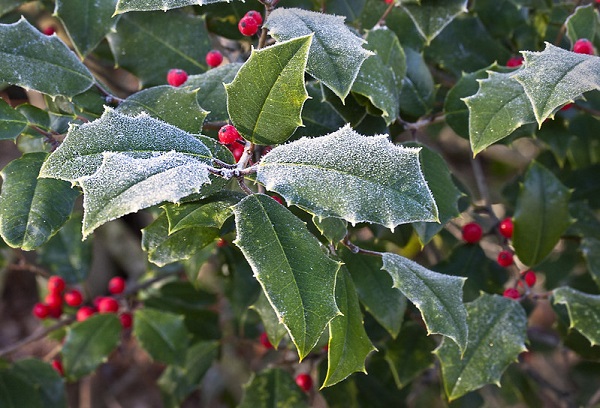
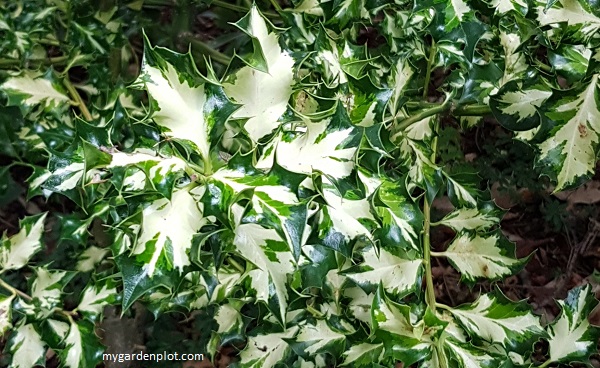
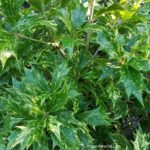
The traditional dark-green spiky foliage and vivid red berries against a snowy backdrop is the quintessential winter image when we think of a holly bush. But there are dozens of varieties with a range of colour and variegated leaf markings offering many choices. One of my favourite is the Ilex aquifolium English Holly ‘Crinkle’ with red berries and creamy-white centre contrasted with a dark-green edge, which brightens up a dull area any time of the year – especially in our region where we seldom get snow but many overcast winter days.
There are so many different species, varieties and new cultivars that may be more suitable for your garden. While we mostly associate hollies as evergreens, there are some deciduous species. Plus, there are sterile cultivars that produce attractive berries that don’t germinate. A quick visit to your local garden centre will help narrow down your choices. Whether you are looking for a ‘traditional’ holly or variegated variety, leaves with or without spines, red berries or white, yellow-orange or even black berries, and there is a range of sizes to suit most gardens, from a small dwarf shrub size of 1 metre (3 ft) tall suitable for container gardening, to a holly tree at 25 metres (80 ft).
Ilex Holly Berries: Male And Female Flowers
Hollies are mostly dioecious plants. Aside from a few self-pollinating (or self-fertile) female hollies – the ‘J.C. van Tol’ and the ‘Pyramidalis’ – most need a male plant to pollinate the female plant, which produces the berries. The flowers are relatively insignificant, and these bloom in late spring. The berries appear for winter. One male holly plant can pollinate about three to four nearby females.
Along with their glossy evergreen leaf, the berries bring colour to a winter garden and are traditionally used as Christmas holiday decorations. The berries are a food source for wild birds when there are fewer options in feeding. While the berries are attractive to birds, they are poisonous to the rest of us. Care should be taken with children and pets.
RELATED TOPIC: DIOECIOUS PLANTS
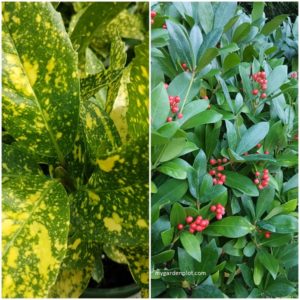
Other shrubs that need a male pollinating plant for berry production include the Aucuba japonica (Japanese Aucuba, Spotted Laurel) and the Skimmia japonica (Japanese Skimmia). Both of these evergreen shrubs are also perfect for winter gardens.
Ilex (Holly) At A Glance
Type: Evergreen And Deciduous Shrubs And Trees
Location: Full Sun (Tolerates Partial Shade)
Seasonal Interest: Winter Berries, Year-round Foliage
When To Prune: Mid / Late Summer (most species – see details below)
Height: 1 – 25 metres (3 – 80 ft)
Plant Hardiness Zones: 4, 5, 6, 7, 8, 9
Where To Plant And How To Grow Holly Bush (Shrub)
Hollies prefer a sunny location but can grow well in partial shade too. They thrive in fertile, humus-rich, moist, and well-drained soil, although hollies can practically tolerate any soil condition. Water regularly during the first year. Once established, they tolerate drier conditions. Holly bushes are tough plants that can even live in polluted areas, such as roads or busy cities. Plant new young holly shrubs in spring or autumn.
RELATED TOPIC: Recommended companion acid-loving plants include rhododendrons and camellias.
How To Care For Holly Bushes (Shrubs)
Step-by-Step Planting & Care
- Plant in spring or autumn.
- Water regularly the first year; established plants are drought-tolerant.
- Apply mulch in spring to retain moisture. Fertilize annually in spring with a slow-release fertilizer for acid-loving plants.
How To Prune Holly Bushes (Shrubs)
Hollies are slow-growing shrubs, and this is especially true with holly trees. The shrubs usually form with a central stem (or leader as with a tree) and with side branches. Giving it an easy natural shape to keep uniformed.
Generally, regular pruning is not required, though an annual light prune will help maintain a balanced, shaped holly shrub. Always start any pruning by removing any damaged or dead branches. And also, check and remove any crossing or rubbing branches. Pinching or shearing a holly bush encourages dense growth. Neglected holly bushes or hedges cut hard back will encourage new shoots to develop from the base.
When required, holly shrubs can tolerate hard pruning and are suitable for hedging and topiary.
Pruning holly should be done in mid to late summer or during the dormant season in late winter. When pruning a spiny leaf variety, it is necessary to use thorn proof gloves to protect yourself.
Pruning Summary
- Generally low-pruning needs. Light, annual pruning maintains shape.
- When: Mid to late summer, or dormant late winter. Use thorn-proof gloves for spiny varieties.
- Method: Remove dead, damaged, or crossing branches first. Pinching/shearing encourages denser growth. Holly tolerates hard pruning for renovation, hedging, or topiary.
RELATED TOPIC: Buyer’s Guide On How To Choose Hand Pruners (Secateurs)
Pests And Diseases That Affect Ilex (Holly)
Hollies are generally trouble-free and easy to care for, though some general garden pests such as scale insects, leafminer or spider mites can occasionally present problems. Hollies are rabbit and deer resistant.
Ilex (Holly) Overview
Ilex (holly) is a versatile, low-maintenance shrub or tree, famous for its festive berries and evergreen foliage. It provides year-round garden interest, works well for hedging/screening, and thrives in containers. While generally easy, some species can be invasive.
Key Considerations:
- Many varieties exist with different leaf colors, variegation, berry colors (red, white, orange, black), and sizes.
- Berry Production: Most hollies are dioecious—you need one male plant to pollinate 3-4 nearby females for berries. Exceptions are self-fertile females like ‘J.C. van Tol’.
- Toxicity: Berries are poisonous to humans and pets (but attract birds).
- Ilex aquifolium (English/Common Holly) is invasive in some regions (e.g., British Columbia). Birds spread its seeds, which can smother native plants. Consider sterile cultivars or non-invasive varieties.
Tools Recommended For Pruning Holly
Below is the list of essential tools needed to prune Ilex (holly shrub). While mature hollies grow slowly, pruning helps maintain your well-shaped shrub. You will need a good pair of thorn-proof gloves for the job.
- Pruners – Bypass pruners are the most popular choice for gardeners and a must in a pruner’s tool kit. Bypass means the blades pass each other in a scissor-like action providing a clean cut without splintering the stem’s edge. The anvil-type pruner, where the upper blade cuts against a lower flat edge, must always be kept sharp. Otherwise, it will crush the stem while trying to cut it.
- Long-handled Loppers – These are similar to pruners but with long handles. These are heavy-duty and great for more challenging stems that may be hard to reach or too thick for pruners. This will make your pruning hollies easier. Thorny hollies are not the type of shrub you may want to brush up against. So consider using the long-handled loppers with extendable handles for extra leverage.
- Pruning Saw – Saws are useful for thick stems that are growing close together. A Grecian saw or Japanese-blade pruning saw is a handsaw with a curved edge that works with a pull-stroke action. Great for those stems that pruners and loppers can’t cut. It will need a protective case. We also recommend a folding hand saw with a pull-stroke action for smaller gardens. It looks similar to a large pocket knife and works in the same manner as a Grecian saw.
- Shears – You will need a standard pair of shears if you grow your holly as an evergreen hedge. Some have a notch at the base of the blade that enables cutting thicker stems.
- Thorn-proof Gloves -This is a necessary item for you to handle the tough thorny leaves of a holly.